Hatching
Chicks first "pip" by poking a pocket-sized hole in the egg. They then chip at the shell until they can push button off the top. Chicks take upwardly to 3 days to chip their style out.
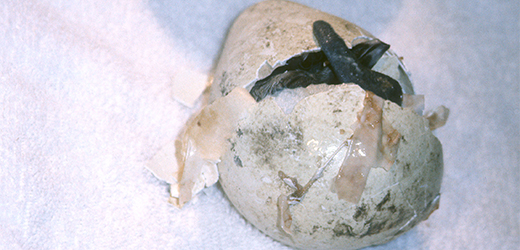
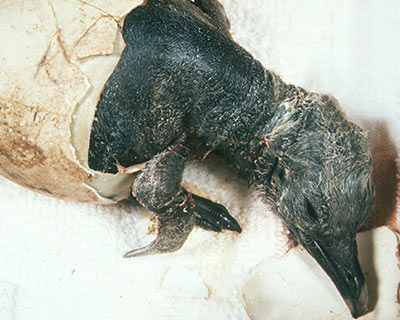
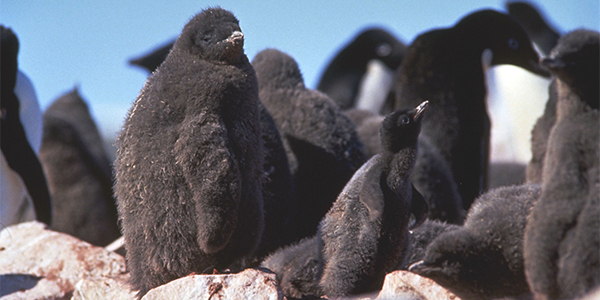
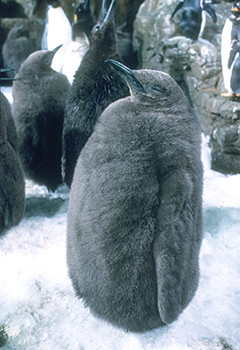
Fine downwards feathers encompass most newly hatched chicks. (King penguin chicks hatch naked and grow downwardly feathers within a few weeks.)
- Downward feathers of unlike species may be white, gray, black, or brown.
- Downwards feathers are not waterproof, and chicks must remain out of the water until they acquire their juvenile feather.
- Developed plumage is acquired at well-nigh one year.
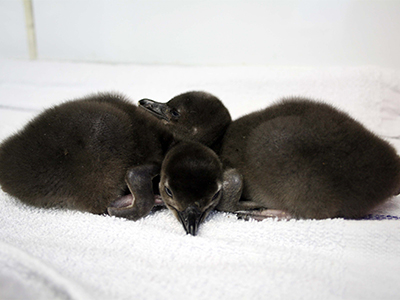
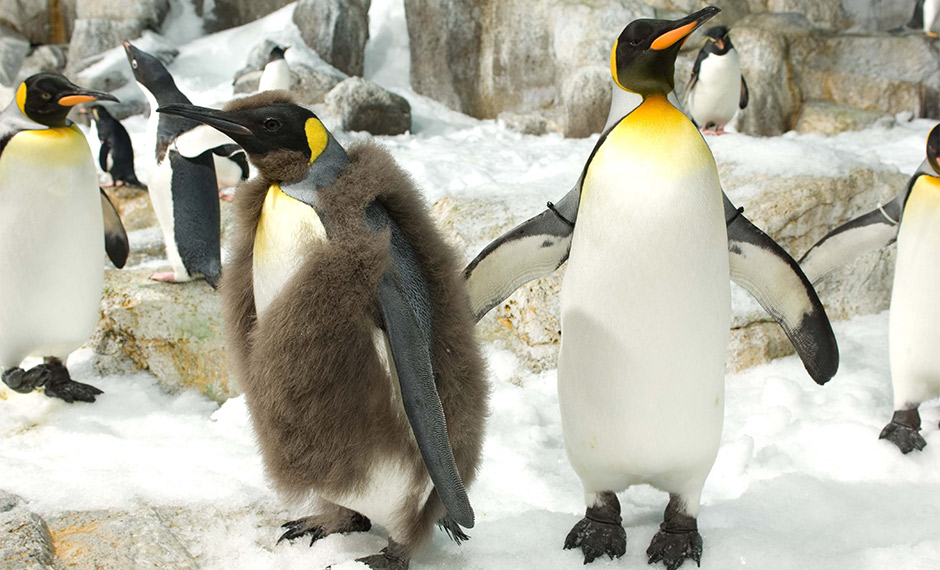
In all species, the coloration and markings of chicks split them from adults. Scientists believe that the chicks' coloration elicits parental behavior from the adults, and that adult penguins exercise not perceive the young birds every bit competitors for mates or nesting sites.
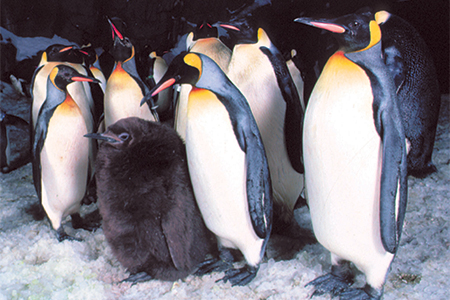
The hitting markings of emperor chicks may help to make the chicks more visible against the ice and snow, significant because emperors don't accept individual nest sites where the young can be found.
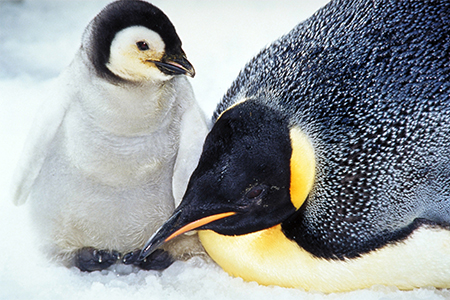
Care of the Chicks
Chicks require attentive parents for survival. Both parents feed the chick regurgitated nutrient. Adults recognize and feed only their own chick. Parents are able to identify their chick by its distinctive call.
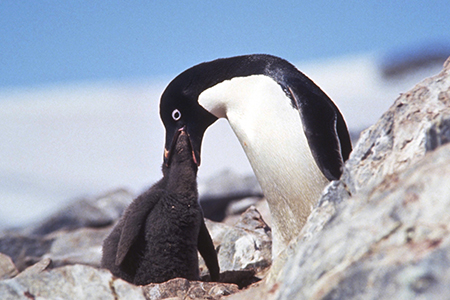
Penguins feed their chicks regurgitated food.
During fieldwork at the Falkland Islands, a researcher observed a beliefs never witnessed before—an older gentoo chick was recorded several times regurgitating food and feeding its younger sibling. It is not understood why the older chick would feed its younger sibling, as in theory such an action would likely reduce the older chick's chances of survival.
Male emperor penguins exhibit a characteristic unique amongst penguins. If the chick hatches earlier the female returns, the male, despite his fasting, is able to produce and secrete a curdlike substance from his esophagus to feed the chick, assuasive for survival and growth for up to two weeks.
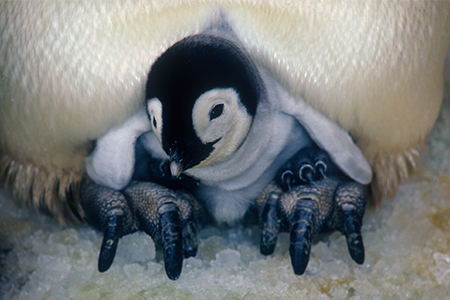
Parents brood chicks (keep them warm) by covering them with their brood patch.
In some species, partially grown chicks gather in groups called crèches. (Crèche is a French word for crib.)
- Crèches provide some protection from predators and the elements.
- Crèches were once idea to be functional nurseries with adults providing protection and communal care. This has proven not to exist the instance. Parents feed only their own chick.
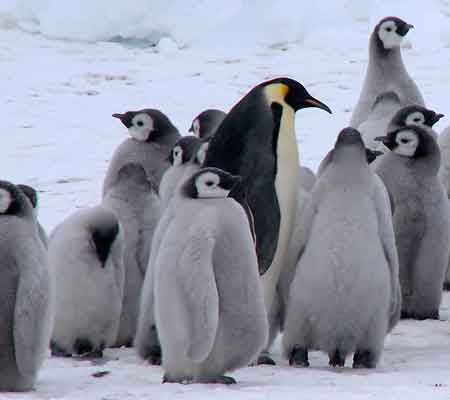
- King chicks are believed to form crèches for protection confronting harsh atmospheric condition, predation, and aggressive, non-related adults.
- The preferred place for a king penguin crèche to form is in the central parts of the colony.
- A contributing factor for king chicks to join a crèche comes from harassment by non-related king penguin adults—lone chicks suffered the most aggression past non-related adults with those that had joined a crèche suffering the to the lowest degree.
- The outer edges of a crèche are the most vulnerable to predation, and king chicks at the periphery appeared to exist more than vigilant when resting based on measuring the fourth dimension they kept their optics open.
- At times intense competition flared between chicks for access to the center of the crèche. Chicks in the poorest wellness were pushed to the edges of the crèche where they were preyed upon by behemothic petrels.
- When weather turned severe, king chicks formed larger, more condensed crèches. Spacing between individual chicks decreased and the chicks turned their backs to the air current and rain.
- Temperate or subtropical crested penguins, like the macaroni or cock-crested, and penguins that nest in burrows, like the little or Humboldt, do non form crèches.
Chick "adoption" and "kidnapping"
During a ii yr study of emperor penguins in Antarctica, mainly non-convenance adult females and failed breeding female person emperors often "kidnapped" and attempted to "prefer" chicks that conspicuously were not their own.
- Out of 2,068 chicks hatched in the colony in 1993, adoption occurred in 351 cases. Adoption took place 185 times out of the 351 cases (53%) subsequently the kidnapping of a chick or where a chick was plant wandering around the colony. Chicks were one to two months onetime.
- Most adoptions were brusque-lived events, lasting an average of 0.v to 10 days. Attempts to feed the adopted chicks were seen in a minimum of nigh 15% of the cases (52 out of 351.) Long-term adoption was seen in only about 2% of the cases.
- Virtually adoption attempts ended desperately for the chick. "Readoption" of a chick to its true parents was but seen in rare instances where the chick was taken shut to its true parents just was quickly abandoned past its kidnapper.
In contrast to most bird species, penguins generally maintain loftier levels of the hormone prolactin (PRL) throughout their unabridged breeding season, fifty-fifty those that may lose their eggs or chicks.
- PRL is also referred to as the "parenting hormone" for its connection in maintaining the strong bond betwixt a chick and parents. The kidnapping beliefs witnessed in adult emperor penguins is believed to be a result of high levels of PRL.
- Emperor adults that had their PRL levels artificially decreased (by the administration of bromocriptine) kidnapped chicks at a lower level than those that maintained higher levels of PRL.
At least 65 bird species have been known to "adopt" the immature of a unlike species, including i instance where a rex penguin attempted to raise a brown skua chick.
- Developed brown skuas are natural enemies of king penguin chicks. Brown skua chicks, however, are dark-brown with fuzzy downwardly that may superficially resemble a newly hatched king penguin.
- A rex penguin adult was seen pushing a brown skua chick onto its feet, apparently attempting to brood the skua as information technology would a newly hatched king penguin chick.
- Both skua parents attempted a rescue past harassing the penguin. Twice they succeeded in taking their chick back, still, the determined king fought back and retook the chick by chirapsia its flippers and pecking at the parents. Human intervention by one of the observers finally concluded the disharmonize and the chick was returned back to its real parents.
Chick Evolution
A chick depends on its parents for survival between hatching and the growth of its waterproof feathers before it can fledge (leave the colony to go provender at bounding main.)
- This period may range from seven to nine weeks for Adélie chicks to xiii months for male monarch penguin chicks.
- For virtually penguin species, in one case a chick has replaced its juvenile down with waterproof feathers it is able to enter the water and becomes independent of its parents.
- Some juvenile gentoo penguins that have undergone a consummate molt, go out the colony to forage at sea during the mean solar day but return to the colony with some still receiving food from their parents for an average of 12 days following their first foraging trip at sea. Post-obit this flow of extended parental care the gentoo fledglings disperse from the colony.
0 Response to "Captured on Video, Baby Emperor Penguins March to Their First Swimming Lesson"
Post a Comment